A local defence company offers the kind of command and control systems old generals could only have ever dreamed of, writes Paul Ash
There was a time not so long ago when Cobus Valentine, a veteran infantry officer, used to tell people at his presentations that it was men who made wars but machines that finished them. Nowadays, Valentine, chief commercial officer of product management for defence and security firm GC2T, prefers to start his presentations with French philosopher René Descartes’ famous epiphany: I think therefore I am. “But for how long?” adds Valentine. That quip usually gets potential customers to sit up and take notice, he laughs.
His remark captures precisely the ever-rapid pace of development in the defence and security sectors as digital technologies brush the old world aside. GC2T offers digital command and control solutions to defence forces, private companies and even other nations. Its platforms are used to train officers in military procedures, to test doctrine and optimise plans.
The company started as Cybersim in the late 1980s when South Africa was still embroiled in the war in Angola and then South West Africa. Back then, planning for operations was done using physical models.
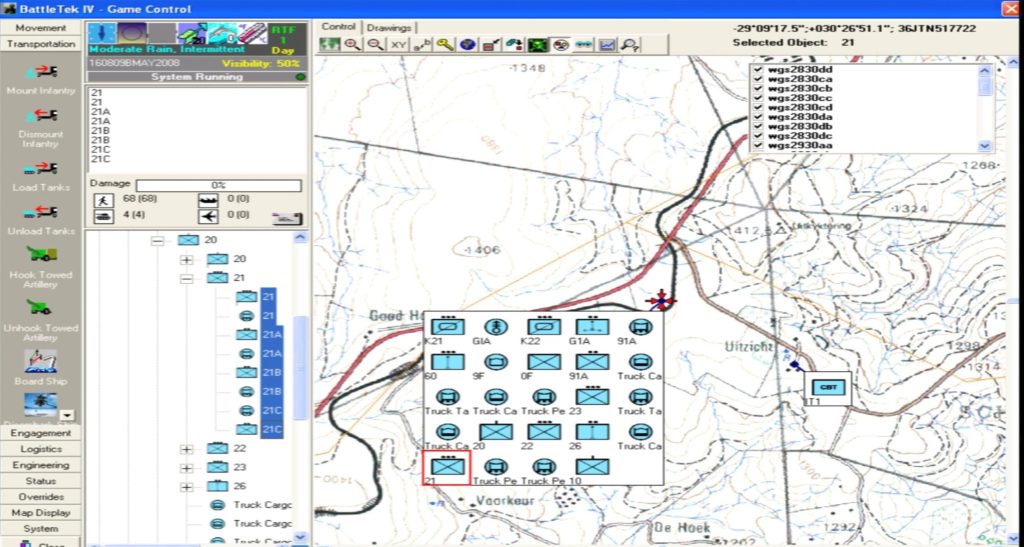
“In the old days you’d build a sand model and physically take the units through the plans,” says Valentine. “Today it’s more like a computerised wargame.”
The technology allows for much broader testing of battle plans. Numerous scenarios can be tried and tested in a wargame scenario which means possible outcomes can be determined more accurately. It’s an environment in which many young people who have grown up with Sony PlayStation and Xbox will be entirely familiar. “I keep saying we have to get more youngsters into defence,” says Valentine.
Africa defence dividends
In an increasingly uncertain world, GC2T’s products have found users all over Africa as well as in the Middle East and Far East. Two NATO countries are also company clients although Valentine declines, as he must, to say who they are. The firm competes with global heavyweight firms such as Thalys and countries such as Israel, China and Russia.
“We are the only original equipment manufacturer (OEM) in Africa that does what we do,” he says. Being “system agnostic”, the company also works with every defence company in SA, he adds. Local clients include the SANDF and well as private businesses.
At the time of writing, Valentine was busy preparing to travel to the SA Army’s Combat Training Centre at Lohatla in the Northern Cape to deploy and test a new Chaka combat suite. Chaka is a digital command and control system that provides situational awareness and messaging across numerous communications links, including combat net radio, local area networks, wide area networks, satellites and point-to-point serial links.
The suite is loaded with graphics, maps, tools and displays that offer commanders a tactical view of the battlefield generals of old could only have dreamed of. It can also be integrated with the company’s other offering such as its Air Picture Display System (APDS) and Battletek, a wargaming system. APDS integrates the available air power resources into a single flight command and control system, allowing complete control of air assets as well as an accurate picture of the situation.
Gaming is everything
Battletek, meanwhile, is the sort of tool that can help defence forces optimise training even as governments slash defence funding. The SANDF is under increasing financial strain as it battles for money. Training is often one of the first casualties of budget cuts which, in turn, reduces operational readiness. Wargaming suites such as Battletek, then, offer a solution in these economically difficult times.
The suite is a wargame simulator that covers field exercises and training on the tactical and operational command levels. The system allows trainers to improve leadership competencies and to practice the “Art of War”, the company says.
The latest version of the suite allows a situational awareness picture to be shared with participating units anywhere in the world even if they have only limited internet access, while a full-scale simulation can be carried out with any unit with access to a VPN.
The art of the long game
If the technological advances have been satisfyingly rapid, the pace of winning and implementing contracts has been less so. One of the company’s main challenges is the turnaround time to land and execute a contract, a process which can take between two and five years, says Valentine.
“It’s not like selling a tin of fish where you’ve got your return on investment,” he says. “You don’t always get your money right away either so cash flow is critical for small companies like us.”
Still, the future looks bright for local firms such as GC2T, which has contracts in 11 African countries. “Africa is starting to turn away from the big, foreign OEMs,” says Valentine.