For decades South Africa has been a world leader in the military unmanned aerial vehicle (UAV) market and continues to offer top class products, including the largest UAV to be made on the continent.
The South African Air Force was an early adopter of UAVs, commonly known as drones, experimenting with the first remotely piloted aircraft in the 1970s, and using UAVs in combat in Angola in the 1980s. The industry advanced rapidly in the 1990s, producing exotic designs like the Flowchart II stealth demonstrator. However, post-democracy defence budget cuts meant government funding dried up and many projects were axed, but the private sector continued to drive UAV development.
Milkor
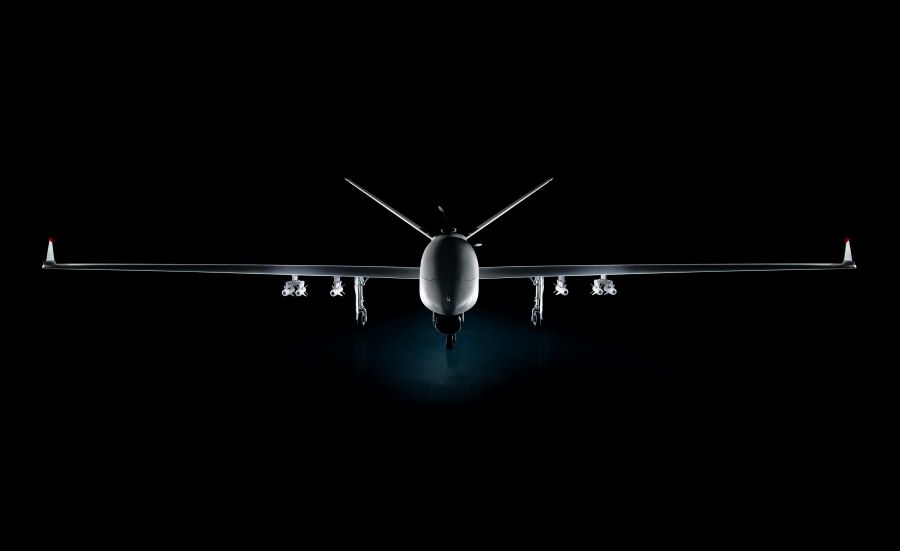
Today, one of the flagship UAVs to be manufactured in South Africa is the Milkor 380 – the largest UAV to be built in the country. With a wingspan of 18.6m it is nearly twice the size of a Cessna 172, which has a wingspan of only 11m. Endurance is up to 35 hours while payload capacity is 210kg (maximum takeoff weight is 1,300kg). With such a large payload, a wide array of weapons and equipment can be carried, such as synthetic aperture radar, jammers and electro-optical gimbals. Five hardpoints can carry precision guided weapons such as the AL TARIQ X-series and HALCON Desert Sting or Thales Belgium FZ602 rocket launchers.
The Milkor 380 was first unveiled in 2018 and flew for the first time in 2023. The first of five aircraft to be built will be dedicated for South African use, and Milkor has signed a memorandum of understanding with the Department of Defence, Armscor and the SA Air Force to this effect.
As the Milkor 380 is designed and developed locally, it is free from the US International Traffic in Arms Regulations (ITAR) regulatory regime on military and related technologies and can therefore be exported to more markets around the world. This is something that makes most South African defence equipment attractive globally as South Africa is a non-aligned country.
“Developing such a sophisticated platform in South Africa is a significant achievement for the defence industry. Milkor has created an opportunity for the South African defence, security and intelligence sectors to source key equipment locally, eliminating the need to seek them elsewhere.” say
Daniel du Plessis, Business Development Manager at Milkor.

Hensoldt
Another company that is a relative newcomer to the UAV market but which is making a big impact is Hensoldt South Africa. As one of the biggest defence companies in the country, Hensoldt made a name for itself with electronic warfare and optronics systems – including gimbals for UAVs and other aircraft. It now offers the ASTUS UAV, which was first unveiled in 2018. Key features include a 5.2 metre wingspan, 115kg maximum take-off weight, eight hours, flight time and 10kg payload. The real strength of the aircraft is its sensor package – when fitted with a 30x optical zoom Epsilon 180 gimbal, the aircraft can track a golf ball from 2.5km away. This was proven during demonstration flights to potential customers in November 2022 – the aircraft also read the name painted on the side of a ship 10.5km off Saldanha.
Impressive results were achieved with the Epsilon 180 gimbal, but the new lightweight Argos-8 will also be fitted this year. Willie Malan, Manager Unmanned Systems at Hensoldt Optronics, noted that artificial intelligence and imaging technology have improved tremendously in recent years, and this is what gives the ASTUS its edge – the gimbal can automatically track cars, people, animals and other moving objects.

The CSIR
The Council for Scientific and Industrial Research (CSIR) pioneered the use of UAVs in South Africa and was among the first entities globally to develop unmanned aircraft. Together with Kentron, the CSIR in the 1970s manufactured the propeller-driven Champion, several of which were evaluated by the Air Force. Further efforts with Kentron led to the Seeker, which was deployed by the Air Force in Angola in 1987 for surveillance and artillery spotting.
Over the years the CSIR has developed multiple big and small UAVs, such as its Long Endurance Modular UAV (LEMU). The twin-engine aircraft features a modular payload pod mounted under the centre of the fuselage. Other designs to come from the CSIR include the Sekwa 1.7m wingspan blended wing-body UAV used for research, and the 2m wingspan Indiza. The latter has been manufactured for the SA National Defence Force and used on border patrols as well as peacekeeping operations in the Democratic Republic of Congo.
The CSIR’s latest UAV project is a hydrogen-powered aircraft that will use locally developed fuel cell technology. Development falls in line with the Department of Science and Innovation’s Hydrogen Society Roadmap that aims to develop a sustainable and competitive hydrogen economy in South Africa by 2050 as well as decarbonise aviation. The timescale for development is 2022-2026 and this could lead to the development of fuel cells for a general aviation aircraft (2026-2029) and regional airliner (2029-2034). As the CSIR is focused on technology development it hopes to license its fuel cell propulsion system to a local entity that can commercialise it. The CSIR has reported strong interest from local and international operators as well as the military.
The UAV is intended for civil and military applications, including surveillance, with a reconfigurable payload bay capable of carrying up to 5kg. It will use multiple rotors for vertical takeoff and landing, and rely on a fixed-wing for horizontal flight. Endurance is expected to be more than 10 hours.

Denel
Up until its recent financial troubles, state-owned Denel Dynamics was one of South Africa’s leading UAV manufacturers – unfortunately, due to financial challenges and a resultant staff exodus, it has limited ability to manufacture at present, although the firm is optimistic it can turn itself around. Denel (through predecessor Kentron) made its name in the UAV industry with the Seeker and then the improved Seeker II, which featured greater range and payload options such as electronic surveillance systems. Aircraft were exported to Algeria and the UAE, with the latter using it in Afghanistan on behalf of the United Nations.
Not content to rest on its laurels, Denel Dynamics evolved the aircraft further into the improved Seeker 200 with up to 40kg of payload, and exported this to the UAE, where it was armed with small guided weapons. The UAE has until recently been an enthusiastic Seeker operator, and also acquired the larger Seeker 400. This can, unusually, carry two sensor payloads (weighing a combined 100kg) and be armed with guided weapons. The first flight was in February 2014, and since then the type has been delivered to the Defence Intelligence division of the SANDF and the UAE.
Paramount
As a privately owned defence company, Paramount has a substantial UAV portfolio. It acquired ATE (now Paramount Advanced Technologies), which developed the Vulture UAV in the 1990s for the South Africa Army. The Vulture is used for artillery spotting and can be launched via a truck-mounted system, and does not need a runway for recovery as it is captured with a net and inflatable air bag.
ATE also developed the small hand-launched and battery-powered Kiewit for use by special forces and infantry; this has been exported. Paramount Advanced Technologies subsequently developed the Mwewe, Civet and Roadrunner (Meteorite) UAVs, but the company’s main focus is now on developing mission systems. UAV swarms is the next frontier in drone development and Paramount is not being left behind. In early 2021 it unveiled its long-range precision strike swarming UAV system: the N-Raven. This can loiter for two hours and carry numerous sensors and munitions weighing 10-15kg.

S-Plane
Although it specialises in UAV avionics and systems S-Plane has also produced two drones: the 7.5m wingspan Swift and smaller Nightingale, which was originally developed to airdrop medical samples. The Swift can accept a variety of payloads including AIS, optical, infrared, multi-spectral and signal/electronic intelligence.
One of S-Plane’s flagship products is its X-KIT solution that allows for the rapid conversion of aircraft into manned, unmanned or optionally piloted aircraft. The X-KIT has been fitted to the Fama Kiss 209 helicopter, Indra Targus optionally piloted vehicle and Ultimate Unmanned Viper 1000C (based on the Stemme S15 motor glider). Airbus also chose S-Plane to supply its X-KIT for its eXtra Performance Wing demonstrator project, which will see X-KIT installed on a remotely controlled Cessna business jet. Another new customer is Paramount, which in 2022 signed a memorandum of understanding with S-Plane Automation to integrate its optionally piloted vehicle solution onto Paramount’s Mwari military aircraft.
UAVs are no longer a niche capability for militaries – they are an essential component of the modern military and South Africa is ready to supply big or small and armed or unarmed aircraft. Although the competition is stiff, South African defence companies punch above their weight and are taking the fight to big players – the likes of the US, China, Russia and Turkey.