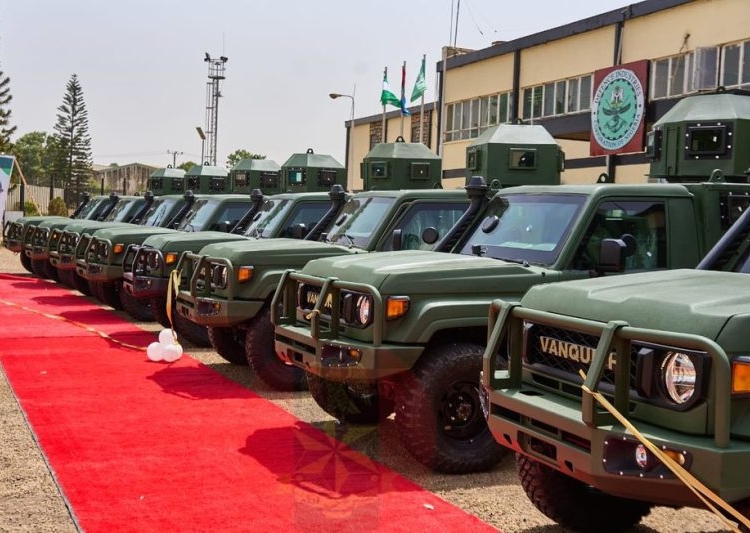
Modern desert operations place unique demands on military vehicles. Extreme temperatures, loose sand and vast operational distances require platforms with strong cooling systems, high ground clearance and the flexibility to support multiple mission roles. Responding to these challenges, the South African defence manufacturer Milkor revealed its new Frontier XL High Mobility Light Tactical Vehicle (HMLTV) at the World Defence Show 2026 held in Riyadh, Saudi Arabia.
Still in its prototype stage, the Frontier XL has been engineered with the operational requirements of the Middle East in mind. Rather than modifying an existing vehicle for desert environments, Milkor developed the platform from the ground up to operate effectively in the harsh climatic conditions typical of the region.
One of the key design considerations is thermal management and dust protection. Military vehicles operating in desert climates must remain reliable in temperatures that frequently exceed 50°C. To address this, the Frontier XL incorporates an enhanced cooling system designed to maintain stable engine and transmission performance during demanding operations such as high-speed manoeuvres in deep sand.
The vehicle’s geometry has also been carefully optimised for challenging terrain. With an approach angle of 60 degrees and a departure angle of 40 degrees, the Frontier XL is capable of negotiating steep dunes, rocky slopes and dry riverbeds without damaging the chassis. A fording capability of 750 mm, combined with a gradient climbing ability of 60 percent, further supports its role in long-distance desert patrols and rapid-response missions.
In terms of weight and payload, the Frontier XL falls within the 7,000 kg Gross Vehicle Mass category. With a tare weight of approximately 5,000 kg, the platform provides a payload capacity of around 2,000 kg. This allows operators to carry additional fuel, ammunition, communications systems and other mission-specific equipment.
Power is generated by an engine producing 165 kW, or roughly 221 horsepower. This provides a power-to-weight ratio of approximately 23 kW per ton, equivalent to 31 horsepower per ton. Maintaining adequate power in relation to vehicle mass is especially important in sandy environments, where rolling resistance is significantly higher than on paved surfaces. The Frontier XL can reach speeds of up to 130 km/h, allowing rapid deployment across road networks before transitioning to off-road terrain.
Operational range is another important factor for forces operating across large desert areas. According to Milkor, the vehicle offers an on-road range of about 640 km, while off-road endurance is estimated at approximately 360 km. These figures enable extended patrol operations with limited reliance on logistical support.
Protection is provided through a standard B6 ballistic armour configuration, designed to withstand most small-arms threats typically encountered during border security or counter-insurgency missions. For operations in more hostile environments, the vehicle can be fitted with optional armour kits that raise protection levels to NATO STANAG 4569 Level 1 for both ballistic and blast threats.
This modular protection concept allows operators to balance survivability with mobility and fuel efficiency depending on mission requirements. Vehicles can therefore remain lighter for routine patrol tasks while still offering the option of increased protection when operating in higher-risk areas.
Milkor’s growing focus on sensor technology and autonomous capabilities also contributes to the broader operational concept behind the Frontier XL. In 2025 the company signed a memorandum of understanding with HGH Infrared Systems to integrate SPYNEL-M thermal imaging systems into its maritime platforms. These sensors enhance situational awareness and assist vessels in complying with the International Regulations for Preventing Collisions at Sea.
Although initially developed for maritime applications, the surveillance and sensor technologies involved have clear relevance for land-based missions. Long-range thermal detection systems can support reconnaissance operations conducted by vehicles like the Frontier XL, particularly in remote border regions where visibility and early detection are critical.
The Frontier XL’s introduction also coincides with Milkor’s continued expansion into the aerospace sector. In September 2023 the company’s Milkor 380 UAV completed its maiden flight. With a wingspan of 18.6 metres and a maximum take-off weight of around 1,300 kg, the aircraft is currently the largest armed unmanned aerial system developed in Africa. Designed primarily for intelligence, surveillance, target acquisition and reconnaissance missions, the drone can carry an external payload of up to 210 kg.
The combination of long-range aerial surveillance provided by the Milkor 380 and highly mobile ground platforms such as the Frontier XL could offer military forces an integrated operational capability. This is particularly relevant for countries within the Gulf Cooperation Council, where extensive desert borders require persistent monitoring and rapid-response mobility.
Milkor’s decision to debut the Frontier XL in Riyadh reflects an evolving strategy among defence manufacturers targeting the Middle Eastern market. Instead of simply adapting Western vehicles for desert climates, companies are increasingly developing systems designed specifically for the environmental and operational conditions of the region.
This approach also aligns with broader regional initiatives such as Saudi Vision 2030, which encourages partnerships with international defence companies and emphasises equipment that can operate effectively in demanding local conditions while reducing maintenance costs.
The Frontier XL is currently undergoing prototype testing, with Milkor indicating that feedback from regional partners will be incorporated into the final design. Such collaboration is intended to ensure the vehicle meets the operational doctrines of Gulf military forces, which often favour fast-moving, independent units capable of covering large distances quickly.
For Milkor, the Frontier XL represents an important step in the company’s evolution. Traditionally recognised for its grenade launcher systems and patrol vessels, the firm is increasingly positioning itself as a broader defence technology provider.
The vehicle’s ultimate success will depend on how it performs during future trials and evaluations. If the platform proves capable of delivering the expected levels of mobility, durability and thermal resilience, the Frontier XL could become a competitive entrant in the global market for light tactical vehicles.
In an era where modern conflicts increasingly demand fast, adaptable and technologically integrated platforms, Milkor’s new vehicle offers a modular solution aimed at supporting the operational needs of expeditionary and border security forces operating in some of the world’s most demanding environments.