A grinding war and fears of skies ruled by Russian Migs spurred one of the greatest aviation upgrades of all time
Nineteen eighty-three was a tough year for the former South African government. Revolution was in the air. The population was becoming increasingly agitated. The government was grappling with a looming insurgency, from both the left and the right, at home, while also fighting a war in Angola.
Bomb blasts destroyed restaurants, power pylons and railway lines. A top-ranking spy was unmasked at the SA Navy Dockyard while the Border War got hotter as Cuba committed more money and weapons and troops to Angola’s struggle against Unita. The war, becoming steadily unpopular back home, was costing the country R1m a day.
Meanwhile, the effects on a long-running arms embargo were being felt throughout the armed forces and especially by those at the sharp end, including SAAF fighter pilot and combat flying instructor Johann Venter.
“We had a very poor sighting system,” he says. “The whole system was very old.”
When he talks about sighting systems, Venter, who joined the SAAF in 1971, is talking about the Dassault Mirage III, a type on which he holds the second-highest number of hours after former SAAF chief Lt Gen Carlo Gagiano.
If the SAAF was a spear, then the Mirage IIIs and F1s were the sharp end. The Russians, via their Cuban proxies, were about to equip the Angolan Air Force with Mig 23 “Floggers” and, for the first time since the Bush War began, there were real fears the SAAF was about to find itself outgunned in the blue skies above Angola.
By 1983, the SAAF’s oldest Mirage IIIs were 18 years old. While the type, which first flew in November 1956, was the fast mover of its time, by the time the Cold War reached its apogee, it had become steadily outclassed.
Meanwhile, thanks to a United Nations-sponsored arms embargo, South Africa could not simply shop around for more modern aircraft. There was, however, a way around the obstacle, one that involved a highly secret transfer of ideas and technology from another international pariah state: Israel.
‘They picked up every piece’
Venter likes to tell the story of the day in 1987 when he and two other fighter pilots took off from AFB Hoedspruit for a quick combat training sortie during an air combat training camp.
Venter was flying a single-seat Cheetah E. The other two pilots, both highly experienced Mirage vlamgatte, were in a two-seat Cheetah D2.
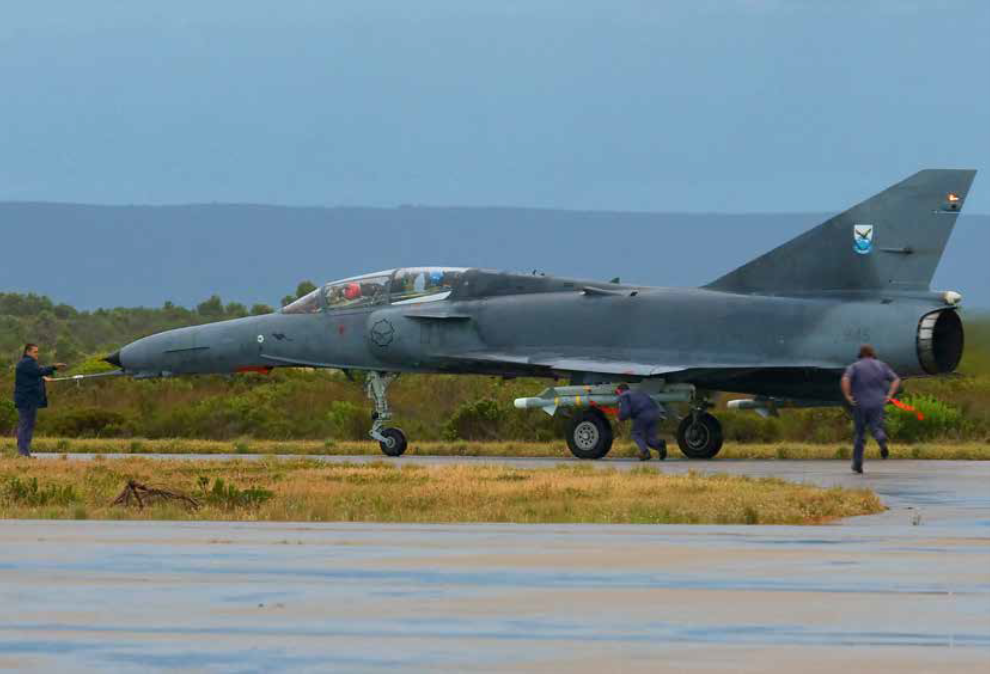
That afternoon, the single-seater was carrying a little more fuel than the D2. A few minutes into the sortie, Venter called the other aircraft to ask about their fuel situation. His transmission was never heard.
“I asked the critical question as their audio fuel warning sounded,” he says. Not long afterwards, as he returned to Hoedspuit, Venter saw a greasy, black pillar of smoke reaching into the bushveld sky. “I knew they would be OK if I saw the aircraft in the shelter when I walked past,” he says.
“But it wasn’t there.”
The D2’s engine had flamed out as the aircraft was returning to Hoedspruit. The pilot wasted precious time trying to restart the engine while the aircraft plummeted from the sky, until his backseater told him they had to get out. Both men ejected with seconds to spare before the aircraft made a smoking crater in the bush. What struck Venter was how quickly people arrived at the scene of the crash to secure the site. It was clear to anyone watching that the investigators were not going to leave anything behind. “They scoured the site,” says Venter, “and picked up every piece.”
Enter the lion cub
That the investigators at the crash scene were not South Africans leads us to the start of the Cheetah project. Like South Africa, Israel was struggling to acquire weapons, thanks to an international arms embargo. The country had previously enjoyed a close relationship with France and especially Dassault Aviation. The Israeli Air Force (IAF), which operated the Mirage III, had been eagerly anticipating the arrival of 50 Mirage 5 aircraft until the embargo scuppered the deal.
Not to be thwarted, Israeli spies acquired Mirage 5 plans which local defence firm Israeli Aircraft Industries (IAI) used to produce a copy of the fighter called the Nesher. While the Nesher acquitted itself well during the 1973 Yom Kippur war, the IAF wanted a more capable ground-attack fighter-bomber.
IAI already had a design in development. It was called the Kfir – Hebrew for “lion cub” – and, for a short time after entering service in 1975, it was the country’s primary jet fighter. It’s no secret, at least not anymore, that South Africa and Israel collaborated for decades on top-secret military projects in which South Africa acquired equipment such as strike craft, air-to-air missiles and a world-class assault rifle, while the Israelis gained the use of a facility where they could test long-range missiles without scaring the neighbours. Or so the story goes.
Both countries had also realised that the only way to get around arms embargoes was to build the equipment they needed themselves. That was easier said than done. Still, by the time Ronald Reagan and Margaret Thatcher came to power and Russia’s Afghanistan misadventure dragged into its third year, the Atlas Aircraft Corporation (now Denel), a division of Armscor and based at what was then Jan Smuts Airport, had developed the capability for building a home-grown jet fighter.
The SAAF engaged Atlas on a handful of projects. One, Project Carver, was for a new generation combat jet that would have replaced every aircraft in SAAF frontline service by the turn of millennium. Another, Project Brahman, was for an upgrade of the Mirage III fleet. The project, which would draw heavily from the Kfir, would upgrade the Mirage IIIs with modern weapons systems, avionics and flight controls.
Certain of the project’s details are still shrouded in murk. Some sources say as many as five Neshers were bought from Israel for testing and later absorbed in the SAAF. Others say a number of Cheetahs were, in fact, Kfirs supplied directly from Israel Aircraft Industries.
While Project Carver continued in secret, by 1985 Project Brahman’s first aircraft were already on the flight line at 89 Combat Flying School at what was then Pietersburg. On 16 July 1986, the Cheetah – a “D” model – was shown to the public for the first time. By 1987, the type was operational within the SAAF.
Bang for the buck
Three Cheetah models eventually took to the skies in South Africa, dubbed “D”, “C” and “E”. In the strange way that life works, the first aircraft to fly was number 805, a “D” model converted from a Mirage IIIDZ, which began fight testing in Israel in 1985.
Another eight D2 aircraft converted from IIID2Z airframes followed, along with five aircraft using airframes supplied by Israel. Meanwhile, the single-seat “E” model was being developed as a stopgap fighter while the “C” model was still being developed. The Cheetah E kept the original ATAR 9C engine but the C and D models were re-engined with the more powerful Atar 09K50C-11.
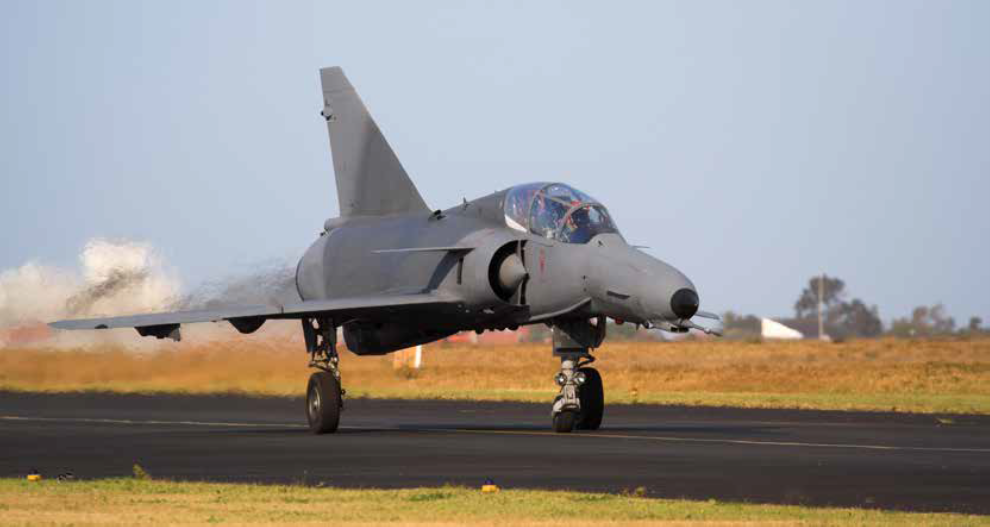
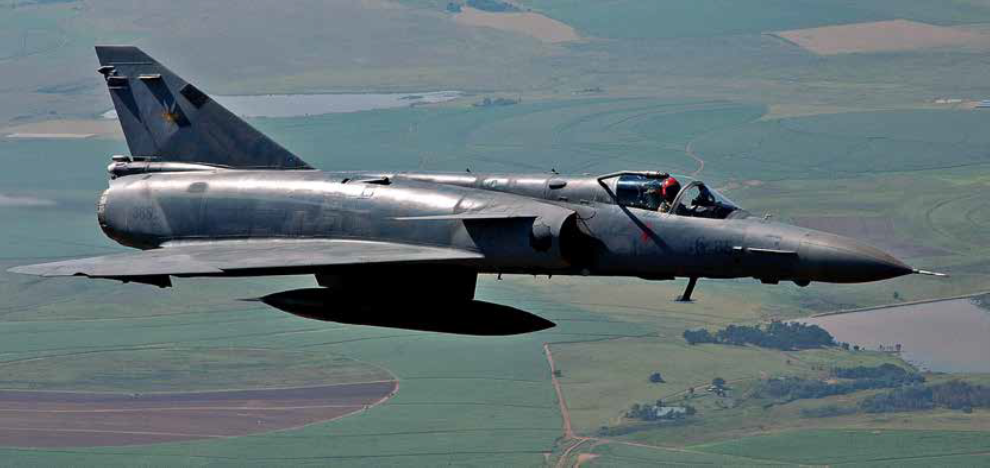
Some 50% of all the airframe components were replaced, effectively returning the aircraft to zero flight hours. Much of the new electronic warfare and self-protection equipment was situated the aircraft’s lengthened nose cone, giving the Cheetah a distinctive shape. Other modifications included a “dog tooth” incision on each wing, computer-controlled elevons, nose strakes and canards near the engine intakes, all designed to improve the original Mirage III’s handling and manoeuvrability.
“The Mirage III is a handful, it’s not an easy aircraft to fly properly,” says Venter. The canards in particular helped improve the aircraft’s handling qualities while the dog tooth incision improved the aircraft’s low-speed handling.
“It was like a new car,” says Venter. “It had lots of extras the Mirage III never had. The weapons and user-friendly navigation systems were so accurate. The Cheetah had everything going for it.”
In the end, the Cheetah never saw combat in the SAAF. By the time the C models entered service, their purpose had all but evaporated. The Border War was over and there were to be no more high-speed dogfights over Angola.
As democracy dawned in 1994, the aircraft found itself on the wrong side of history. The lifting of the arms embargo meant South Africa could have the pick of any weapons systems it wanted, including fourth generation fighter aircraft. By then the Cheetah had already been retired for two years but the D and C models flew on until they were retired from the SAAF in 2008 when the first SAAB Gripens entered service.
The story does not end there for some of the lean cats, however. A handful of E models went to Chile while D and C models have been bought by the Ecuadorian Air Force where they soldier on as frontline fighters.
Another dozen D and C models have found new roles as “aggressor” aircraft in the US where they are used to help train American fighter pilots and their allies in the art of high-speed aerial combat. Not bad for a fighter that first took flight nearly 70 years ago.
Cheetah factsNumber built: 38 (“C” model), 16 (D), 16 (E)In service: 1986-2008MAUW: 13,700kgTop speed: 2,350km/h at altitudeService ceiling: 56,000ftRate of climb: 45,960ft per minuteRange: 1,300km