


Combat in urban areas is an unpleasant reality many armies prefer not to think about. That is easy to understand: Urban combat is complex, costly, dangerous, time-consuming and unpredictable.
Helmoed-Römer Heitman
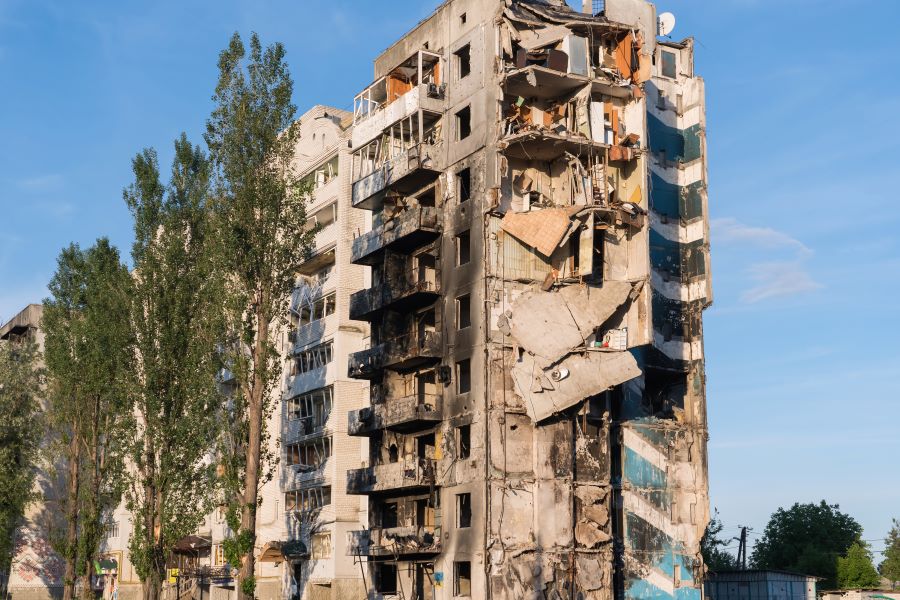
Consider Beirut (1982), Grozny (1994, 1999-2000), Fallujah (2004), Mogadishu (2010-11) and Marawi (2017). More topically, consider that it took Russian forces 12 months and 60,000 casualties to capture Bakhmut, a town of just 42km2.
But urbanisation and the economic and political importance of towns and cities mean that it has become unavoidable and so should receive more analysis and practical experimentation than it generally does.
Urban combat will potentially be even more challenging in developing countries with uncontrolled urbanisation, resulting in large areas of informal housing around towns and cities. There is no planned layout and so no real road maps; there is no logic to the layout, defying guestimates of which alley leads where; there is no easy access between parallel roads; roads and alleys are closely hemmed in by shanties, some double story; any more conventional buildings will be shoddily built and prone to collapse; unsurfaced roads will be easily ditched or mined; rains will bring flooding; the shanties are fragile, offering no resistance to bullets and fragments, immensely vulnerable to fire and, closely packed, also prone to miniature fire storms.
Operating in this environment may require aircraft, helicopters or UAVs for overwatch, tactical control and navigation. That will expose them to fire from heavy machine guns, RPGs – remember Black Hawk Down – or anti-tank or shoulder-launched surface-to-air missiles. These physical challenges will be aggravated by the densely populated nature of informal settlements. People may not be able to flee, and some may be participants in the conflict, requiring a plan on how to handle and care for civilians and how to separate out combatants.

Doctrinal and organisational requirements
The challenges of urban operations will require development of suitable doctrine and may require changes to unit and subunit organisation. Those will have to be developed to suit the most likely scenarios and will need to be extensively trialled in exercises.
Doctrinally, command and control will have to be delegated to the level that best suits each phase of an operation. Exercising command from too high a level will complicate tactical handling and see the senior officers losing situational awareness and overlooking opportunities or threats. Commanders at all levels will need to learn how to command and control with very loose reins and a vast measure of trust. They will have to focus on wider situational awareness, recognising and responding to opportunities and threats, and managing the flow of relief troops and supplies.
The main organisational change will be a higher proportion of infantry in forces likely to engage in urban operations, notorious for demanding enormous numbers of troops. The intensity of urban combat, and the likelihood of it becoming drawn out, will also require enough troops to allow rotation. Then there will be the question of whether the typical battalion of three companies of three platoons of three sections of eight or 10 soldiers will fit the demands of urban combat. While tactical command will happen at low levels, units may need more elements and more troops at each level.
Infantry will be the key force element but very vulnerable without support weapons and equipment optimised for urban combat. Infantry units committed to such operations will need higher ratios of support weapons; more engineer support; APCs for movement; and organic heavy support weapons and armoured vehicles. Organic is the key word: Urban combat is not the place to brush up drills and tactics. Those support elements must be integral to the unit or at least exercise with it frequently enough to build mutual trust and understanding.
One complex issue will be the control of artillery and air support. Troops in contact will often need that support immediately, and only they will know exactly where they need it – “the house two houses down from the one with the yellow door”. That will demand delegation to very low levels. But the air space will be crowded, demanding control at the highest possible level to prevent mortar bombs, artillery shells, UAVs and aircraft from meeting. That will take considerable professional thought and practice to settle.
Communications will also have to be adapted to these organisational requirements as well as to the physical environment, which can be hostile to radio communications despite the claims of manufacturers. At one extreme, individual radios may be essential, impacting procedures; at the other, perhaps UAVs for communications relay.
Another organisational issue will arise from the need to deal with the civilian population. They cannot be left to their fate or to roam around the battlefield and become a problem. There needs to be an organisation to collect civilians, move them to safe areas, make sure they do not wander off, provide water, food, shelter and medical care and arrange for evacuation if necessary. And it will be difficult to separate combatants from civilians.

Tactical and equipment requirements
Urban combat will not demand much change in the basic tactics and drills familiar to any army, except for skills demanded by the environment – moving down a street between tall buildings, clearing a multi-storey building, clearing underground stormwater tunnels or, at the other extreme, fighting among flimsy shanties and among panicked civilians.
Most armies train for urban combat assuming an organised, built-up environment, which will not prepare them for combat in informal settlements. There will be a need to develop a blend of rural village clearing with classic urban house-to-house combat tactics. This will include measures to reduce risk of inadvertent civilian casualties, ways of moving troops quickly despite complex terrain, and ensuring prompt recovery of casualties and damaged equipment before they draw the attention of looters.
On the equipment and weapons side, one issue will be the right mix of personal and light support weapons for fighting in either a formal built-up area or in an informal settlement, as well as a higher scale of support weapons and engineering equipment. There will also be a need for communications equipment ensuring communications at all levels during house-clearing and similar tasks, including personal radios for the combat troops.
Among those requirements will be greater than usual numbers of:
- Personal weapons: Submachineguns (small, reduced wall penetration), shotguns (door breaching, reduced wall penetration, countering small UAVs), pistols (for entry through small openings), PMP’s 20mm PAW, grenade launchers, blast and stun grenades.
- Light support weapons: Compact, low backblast rocket launchers (for enclosed spaces); sniping and anti-materiel rifles, light mortars and something similar to the Switchblade or the Future Infantry Support Missile that was in development at Denel.
Combat troops will need body armour and helmets, perhaps some with pistol/fragment proof visors similar to those used by police, as well as protective equipment to prevent injury when moving fast among rubble.
Organic signals teams should have close-range COMINT capability to monitor opposing force chatter, ideally including monitoring of cellular telephones.
Assault pioneers and engineers will need equipment optimised for urban combat. That will include mine and IED detectors, mine/booby-trap disruption charges, breaching tools and charges, including stand-off breaching weapons, ladders and equipment to quickly extinguish small fires. Heavy equipment will need to include armoured earthmovers to clear rubble and deal with bunkers and strongpoints and, in some cases, also bridging equipment.
There is a widespread but entirely false idea that armour has no role in urban combat. The reality is that tanks and other armoured vehicles will be essential and have been so ever since the urban battles of World War II.
Tanks will be critical, providing an unparalleled combination of precision firepower and protection. They will need to operate together with infantry, and the latter should ideally have infantry combat vehicles optimised for urban operations, with similar protection and multiple high-elevation weapon stations to engage targets in upper floors or on rooftops. Reutech and Centauri both offer suitable mountings. The Israeli Namer is such a vehicle, having grown out of hard, practical experience, and a similar vehicle could be developed using surplus Centurion hulls, as South African engineers did for Jordan. A case can also be made for a variant to counter-UAVs within the urban space, for instance fitted with the Centauri TriAD system.
Should tanks not be available, the fire support variants of infantry combat vehicles could provide direct fire support, albeit at greater risk. Another option could be vehicles with turreted breech-loading mortars, able to deliver direct and indirect fire. Denel’s 60mm mortar suggests itself at the higher end, as does the Patria NEMO system. There has long been the concept of urban fire support vehicles, but the only one in service is the Russian BMPT with its high elevation 30mm cannon, anti-tank missiles and lighter weapons. The German 57mm Marder-based Begleitpanzer was never taken into service.
Simpler APCs will allow troops to be moved swiftly and relatively safely from the rear to the front and around the front. Similarly, ambulances and logistic vehicles will need at least armour protection against light fire.
These vehicles will need good all-round and upward visibility, and all-round and upward target engagement capability and at least lateral and top protection against light anti-tank weapons, IEDs and armed UAVs. A hemispheric variant of a self-protection system such as the Saab LEDS should meet the latter requirement. Basic mine protection will also be necessary. Communications systems should allow any crew member to instantly warn of a threat, and there should be external communications points to allow infantry to speak to the crew while under fire.
The combat vehicles should be tracked or 6×6 or 8×8, to enable them to cross ditches and, in the latter case, to allow them to reverse out of danger after detonating a mine or losing a wheel to an IED. Skid-steering would be ideal for wheeled vehicles, to allow turning in narrow roads, and the idea of a reverse driver might be worth revisiting, or a rear-view video system. Tracked vehicles offer neutral turn capability and good ditch-crossing but are vulnerable to being immobilised by a broken track.
Night vision equipment will be essential and fire-fighting type thermal imagers will be well suited to locating enemy personnel in darkened buildings, and for locating wounded personnel. The infantry will need optical equipment to look over and around obstacles without exposing themselves to fire. Fibre optics should allow solutions more practical than the periscopes of World War I and World War II. Mast-mounted thermal imagers would be immensely valuable. Motion sensors and automated surveillance equipment could be of real value, partly offsetting insufficient soldiers on the ground.
Far from fully exploited, UAVs will be of immense value for reconnaissance, command and control, navigation, communications and targeting for air and artillery support. One could also deploy small “fly and perch” UAVs to provide surveillance of a particular area. Armed UAVs will have great potential for both close support and disrupting the enemy rear area, as demonstrated daily in Ukraine. Unmanned ground vehicles can also be used for reconnaissance, to place demolition charges, bring up supplies or evacuate casualties. Very small “tossable” UGVs will allow a look inside a building. Armed UGVs might be a bit more challenging to use, given the likely presence of civilians, but could be viable if operated on a “man in the loop” basis.
A key question will be which UAVs and UGVs to place at which level. The very small Black Hornet, for instance, could even be at section level, as could “tossable” UGVs. Ideal will be a system that allows multiple users to access the video from UAVs and even to hand off control when necessary.
Preparing the troops
Having the right organisation and equipment will not by itself suffice. Troops will have to be properly prepared. That will involve both training and psychological preparation. The former is obvious, including the fitness required to fight in urban areas, particularly in an area with high-rise buildings, the latter less so.
The psychological preparation requirement also arises out of the specific nature of such operations. Urban combat:
- Is particularly demanding, combining the high stress of ambush risk with frequent close quarters fighting, sniping, booby traps and danger of collapsing buildings.
- Will face soldiers with hostile civilians, who must still be treated as civilians, no matter how aggressive their attitude or how angry and stressed the soldiers.
- Will also face soldiers with ordinary civilians who wish nothing more than to be left in peace, who must be treated with consideration, even if inadvertent injury or death of a child or parent causes them to explode in anger.
Conclusion
Urban operations are particularly complex and demanding, requiring focused training and adapted doctrine and organisations as well as specialised equipment and weapons. It may be worth considering establishing one or two infantry battalions dedicated to the role and also serving to train other units for this role as a backup. It is definitely a form of combat that deserves more study and analysis than it usually receives; approaching urban combat with a business as usual attitude will only result in casualties and, potentially, in failure.


